

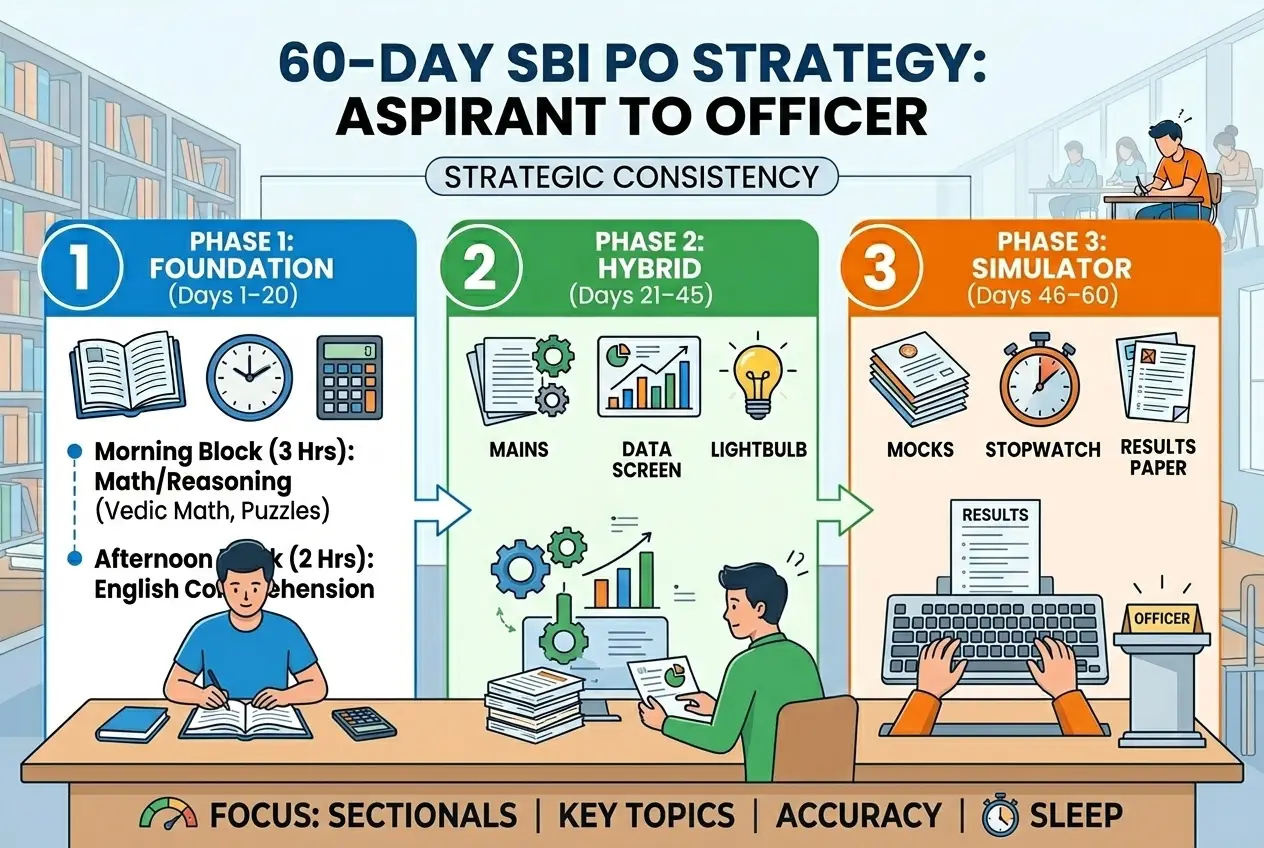
You do not need to study 14 hours a day. You need tactical consistency. This guide breaks down a 60-day plan across three phases — Foundation, Hybrid Execution, and Simulator Protocol — built around how the 2026 exam actually tests candidates, not how it was tested three years ago.
Why Most Aspirants Fail the SBI PO Exam
The most common failure pattern is not weak preparation — it is poor structure. Most aspirants separate Prelims and Mains preparation completely, ignore Banking Awareness until the last month, and take mock tests at random times that have nothing to do with their actual exam shift. The winning approach integrates all three from Day 1.
| The Failing Strategy | The Winning Strategy |
|---|---|
| Focuses only on Prelims for the first 45 days | Integrates Mains-level Data Interpretation from Week 2 |
| Reads generic news without making financial notes | Dedicates 45 minutes daily specifically to Banking Awareness |
| Takes mock tests at random times | Takes mocks precisely during the actual exam shift timings |
What Makes a Successful Study Plan for SBI PO Exam
A winning strategy uses a Hybrid Method — foundational concepts from the Prelims syllabus are immediately tested against high-level application questions from the Mains pattern. It also allocates specific daily time blocks for Current Affairs and Analytical Reasoning from Day 1, not from Day 40. The human brain thrives on achievable milestones. Looking at the entire syllabus at once causes cognitive overload. Compartmentalization is the solution.
Phase 1: Foundation and Cognitive Load Management (Days 1 to 20)
Your goal in the first twenty days is not speed — it is conceptual clarity. Rushing into timed practice now will destroy your confidence before you have built anything solid.
Morning Block: Quantitative Aptitude and Reasoning (3 Hours)
Your analytical mind is sharpest after waking. Use this window for Quantitative Aptitude and Logical Reasoning. Do not touch complex puzzles yet. Focus on Vedic math shortcuts, percentage-to-fraction conversions, and basic syllogism rules. If you cannot calculate 35% of 840 mentally within ten seconds, stay in this phase until you can.
Afternoon Block: English and Reading Comprehension (2 Hours)
English in this exam is a comprehension tool, not a grammar test. Spend one hour reading complex financial and technology editorials. Spend the second hour extracting unfamiliar vocabulary and understanding the author’s tone. This directly prepares you for the Reading Comprehension sets in both Prelims and Mains.
Evening Block: Banking Awareness Foundation (45 Minutes)
Start building your Banking Awareness base from Day 1. Cover RBI structure, types of bank accounts, CRR, SLR, Repo Rate, and Priority Sector Lending norms in this phase. Static knowledge first — current affairs layer comes in Phase 2.
Phase 2: The Hybrid Execution (Days 21 to 45)
This is where the study plan of SBI PO becomes aggressive. Speed and high-level application now run together.
Transition to Mains-Level Practice
Stop doing standalone arithmetic questions. Replace them with Caselet Data Interpretations that mix Profit and Loss, Time and Work, and Probability in a single set. In Reasoning, move from basic seating arrangements to multi-variable puzzles — eight people, eight different attributes, mixed directions. This is the actual difficulty level you will face in the Mains.
The General Awareness Injection
From Day 21, current affairs preparation becomes non-negotiable. Start compiling your own notes on the last four months of banking news. Prioritize RBI Monetary Policy decisions, Digital Rupee (CBDC) updates, major banking mergers, and NPCI announcements. Do not rely on memory alone — written notes reviewed weekly are what actually stick.
Burnout Warning: By Day 30, exhaustion is normal. Apply the Pomodoro method strictly — 50 minutes of focused study followed by a mandatory 10-minute break away from all screens. Skipping the break is what causes burnout, not the study hours themselves.
Phase 3: The Simulator Protocol (Days 46 to 60)
In the final two weeks, learning new concepts is forbidden. You are no longer a student — you are a test-taker in training.
Take one full-length mock test every alternate day. But taking the test is only 30% of the work. The remaining 70% is deep post-mock analysis. Why did you leave that puzzle set? Did you spend four minutes on a single calculation? Identify your time-sink questions and build the discipline to skip them immediately when they appear in the real exam. Accuracy and question selection matter more than raw attempt count.
Two Critical Factors Most Study Plans Ignore
Biological Clock Syncing
If your exam shift is at 8:30 AM but your current habit is sleeping at 3:00 AM and waking at 10:00 AM, your brain will be in sleep inertia during the actual test. From Day 40, your sleep and wake times must match your expected exam shift exactly. This is not optional — cognitive performance at the wrong point in your circadian rhythm costs real marks.
The Descriptive Test Typing Trap
The Descriptive Test is typed on a keyboard, not written. Most aspirants practice essays on paper or on a phone. Neither prepares you for typing on a standard test center keyboard. From Day 30, spend 20 minutes daily typing formal letters and essays on a desktop or laptop keyboard. Target 25 to 30 words per minute with 95% accuracy before the exam date.