By Devesh Sunil Tatkare | Published: 04 March 2026 | Updated: 15 July 2026
Every SBI Probationary Officer enters the bank knowing their starting salary, but very few understand the financial endgame. The rules surrounding the SBI PO retirement age dictate not just when you stop working — they determine how your pension, gratuity, and lifelong benefits are calculated. Before you commit to a 30-year career, you need to understand the exit conditions. Early retirement clauses and pension calculations are far more nuanced than a simple age limit suggests.
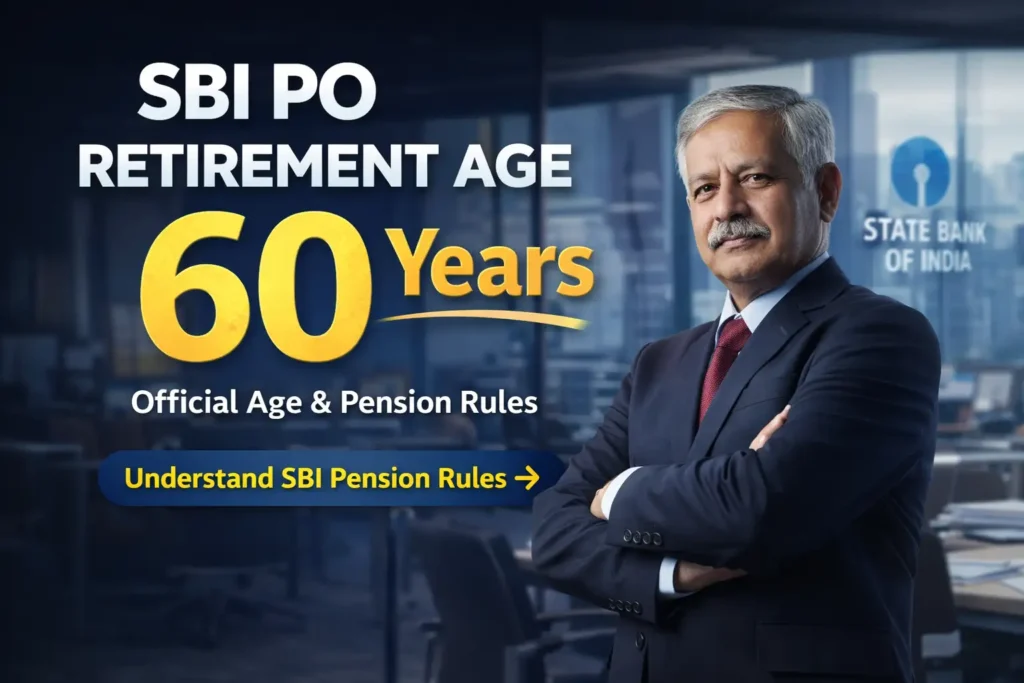
Quick Answer: The official SBI PO retirement age on superannuation is 60 years. You can become eligible for a pension earlier if you take voluntary retirement at 58 (with 10 years of service), at 50 (with 20 years of service), or after completing 25 years of pensionable service regardless of age. Your final pension is approximately 50% of your average substantive salary from your last 12 months — though the exact figure depends on which of the two pension formulas produces the lower result. Always verify your personal computation with HR before your last working month.
What Is the Official SBI PO Retirement Age?
Public sector banks in India standardise officer retirement at 60 years, and the State Bank of India follows this framework without exception. The official Handbook for Retiring Officials uses age 60 as the absolute benchmark. Unless modified by a specific HR circular or disciplinary action, every officer automatically retires on the superannuation date recorded in their HRMS profile upon turning 60. The effective date is always the last day of the month in which you turn 60.
Can an SBI Officer Leave Before Age 60 and Still Keep Their Pension?
Yes — but pension eligibility from early retirement is conditional, not automatic. Leaving the bank before 60 without meeting at least one of the specific milestones below means forfeiting your lifelong monthly pension entirely. The decision to leave early is effectively a financial decision, not just a lifestyle one.
- At 58 Years: Eligible for a pension if you have completed at least 10 years of pensionable service (applicable to employees who joined on or after 1 November 1993).
- At 50 Years: Eligible after completing 20 years of pensionable service.
- After 25 Years of Service: Pension can be claimed regardless of your actual age, once you cross the 25-year service mark.
- Voluntary Retirement Scheme (VRS): Generally available after 20 years of service. Some extended benefits require 30 years of service and a minimum age of 58.
- Medical Incapacitation: If you complete 20 years of pensionable service and are medically certified unfit to continue, a pension may be granted regardless of age.
The Distinction Most Officers Miss: Taking Voluntary Retirement does not change the standard superannuation age of 60. It simply defines the exact point at which you are legally permitted to trigger your post-retirement financial benefits early. Missing one of these milestones — even by a few months of service — can mean the difference between a lifelong monthly pension and none at all.
How Is the SBI PO Pension Actually Calculated?
Your pension is not a flat rate or a simple percentage. It depends on your length of pensionable service and your average substantive salary during your final 12 months. The bank uses two formulas and pays the lower result.
Formula A (Service-Based): Average Substantive Salary x Pensionable Months divided by 720. This formula rewards long service — the closer you get to 720 months (60 years of service), the higher the result.
Formula B (Percentage-Based): For officers with an average monthly substantive salary of Rs 51,490 or below, pension is 50% of Basic Pay plus half of PQA and FPA. For officers above Rs 51,490, it is 40% of Basic Pay with a minimum guaranteed floor of Rs 25,745.
| Average Monthly Substantive Salary | Formula B Result |
|---|---|
| Up to Rs 51,490 | Approximately 50% of average monthly substantive salary |
| Above Rs 51,490 | 40% of Basic Pay, subject to a minimum of Rs 25,745 |
Your monthly pension also includes Dearness Relief (DR), which acts as an inflation buffer revised twice yearly (February and August) based on the Consumer Price Index. DR is calculated on your original full basic pension — even if you have commuted part of it as a lump sum.
Free Estimation Tool SBI PO Pension Calculator 2026 — Estimate Monthly Pension, Commutation and Dearness Relief Stop guessing. Estimate your exact monthly pension, commutation lump sum, and Dearness Relief based on your current salary and joining date.What Are the Gratuity and Commutation Rules for Retiring Officers?
Pension is not the only payout at retirement. Gratuity and Pension Commutation provide the large lump-sum capital most retiring officers use to clear housing loans or fund major family expenses. Both are distinct from pension and follow their own calculation rules.
Commutation of Pension: The Lump Sum Option
Commutation allows you to surrender up to one-third of your basic pension in exchange for an immediate, tax-free lump sum. The deducted portion is fully restored after exactly 15 years. Four things to know before deciding:
- You can commute up to 1/3rd of your Basic Pension.
- The commutation factor at age 61 (next birthday after retiring at 60) is 6.60 under the standard table.
- The formula: 1/3 x Basic Pension x Commutation Factor x 12 = lump sum received.
- If you apply within one year of your retirement date, no medical examination is required.
Gratuity Payout
Gratuity is a statutory right for officers who have completed a minimum of 5 years of service. It is calculated at 15 days' wages per completed year of service (based on 26 working days in a month). The wage components included are Basic Pay, DA, FPA, and PQA. As of the March 2018 amendment, the maximum tax-free gratuity limit is capped at Rs 20 lakhs.
What Financial Benefits Come With Retirement Beyond the Monthly Pension?
Beyond pension and gratuity, the SBI retirement package includes several accumulated benefits that require specific HR procedures to unlock. Most officers are unaware of the exact steps and miss the 3-month advance window that the bank requires for several of them.
| Benefit | Key Details |
|---|---|
| Provident Fund (PF) | Employee contribution + bank's matching contribution + compound interest. Must apply via HRMS within 3 months before retirement date. |
| Leave Encashment | Up to 240 days of Privilege Leave encashed. Income-tax exempt up to Rs 3 lakhs. |
| Health Schemes | SBI Health Assist and SBI Health Care schemes continue after retirement. Medical coverage does not end on your last working day. |
| Fixed Deposit Interest | Retired staff receive an additional 1% interest rate on SBI fixed deposits. |
What Does Voluntary Retirement Actually Cost You — and Why Most Officers Underestimate It?
The most common financial miscalculation SBI officers make is assuming that a 20-year VRS payout is proportionally equivalent to a 30-year superannuation payout. It is not — and the compounding effects make the gap far larger than the missing 10 years of salary suggests.
When you take early retirement at 50, your pension is permanently pegged to a mid-career salary scale, not a Chief Manager or AGM-level salary. Because pension is calculated on your last 12 months' average substantive salary, leaving at 50 locks in a significantly lower calculation base. The same logic applies to PF: the compounding effect on your Provident Fund is strongest in the final 10 years of service. A VRS at 50 can reduce your final PF corpus by nearly half compared to retiring at 60 — because those final 10 years are when the compound growth is most powerful. Treat VRS as an emergency exit, not a financial strategy.
What Should You Do Next?
If you are currently an SBI PO or evaluating the career, map out your financial trajectory using the two pension formulas now — not in your 50s. The gap between what most officers expect and what their actual pension computation produces is one of the most frequently cited surprises at retirement. Verify your personal retirement computation sheet with HR at least 3 months before your last working day, and cross-reference your figures with the official Handbook for Retiring Officials available through your Local Head Office.
If You Are Still an Aspirant SBI PO Eligibility Criteria 2026 — Age Limits, Qualification and Attempt Count Verified Before you think about the retirement end of this career, confirm you meet the conditions to enter it. Age limits and attempt rules affect more applicants than the exam itself does.Frequently Asked Questions on SBI PO Retirement
What is the retirement age of an SBI PO?
The normal retirement age for SBI Probationary Officers is 60 years.
Can an SBI PO take voluntary retirement?
Yes. SBI officers can opt for voluntary retirement if they satisfy the service conditions prescribed under the bank's pension rules.
Do SBI POs get a pension after retirement?
Yes. Eligible SBI officers receive a monthly pension based on the applicable pension scheme and qualifying service.
Does an SBI PO receive gratuity after retirement?
Yes. SBI officers who meet the minimum service requirement are eligible for gratuity as per applicable rules.
Do retired SBI employees get medical benefits?
Yes. Eligible retired SBI employees can continue to receive medical benefits under the bank's post-retirement health schemes.