By Devesh Sunil Tatkare | Published: 02 April 2026 | Updated: 16 July 2026
The SSC CGL syllabus is the same four subjects at both tiers. That statement hides the most important detail. Tier 2 tests the same topics at a harder level, with longer passages, multi-step Maths problems, a doubled negative marking rate, and a section time lock that forces you to manage each subject independently. Reading a topic list without understanding the depth difference between tiers is the preparation gap that costs candidates rank. This guide gives you the complete syllabus for both tiers, the topic-wise weightage, and the depth gap that determines how you should shift your preparation after Tier 1.
Quick Answer: The SSC CGL syllabus covers four subjects: Reasoning, Quantitative Aptitude, English, and General Awareness. Both tiers test the same subjects. Tier 1 is qualifying only (100 questions, 200 marks). Tier 2 Paper 1 tests the same subjects at a deeper level and determines your final rank (390 scoring marks). Paper 2 (Statistics, 200 marks) is only for JSO and Statistical Investigator candidates. Paper 3 has been permanently removed.
What Is the SSC CGL Syllabus 2026 at a Glance?
Before going subject by subject, here is the full structure so you can see where each topic sits and what it counts for.
| Tier | Subjects | Nature | Questions | Marks |
|---|---|---|---|---|
| Tier 1 | Reasoning, GA, Maths, English | Qualifying only | 100 | 200 |
| Tier 2, Paper 1 | Maths, Reasoning, English, GA, Computer Knowledge, DEST | Merit-determining | 130 scoring + 20 qualifying + 1 DEST task | 390 scoring + qualifying |
| Tier 2, Paper 2 | Statistics | Merit-determining (JSO only) | 100 | 200 |
What the table does not show: Tier 1 and Tier 2 test the same subject names but not at the same difficulty. Tier 2 has harder questions, stricter negative marking (-1 instead of -0.50), and a 1-hour section time lock per section. Preparing for Tier 2 using Tier 1 practice material consistently underperforms.
What Is the SSC CGL Tier 1 Syllabus Subject-Wise?
Tier 1 covers four subjects with 25 questions each. The difficulty is moderate. SSC tests breadth at this stage, not depth. Your goal is to clear the cutoff comfortably, then shift preparation focus to Tier 2. Here are the topic-wise question counts based on previous year paper analysis.
General Intelligence and Reasoning
| Topic | Expected Questions (Tier 1) |
|---|---|
| Analogy (Verbal and Non-Verbal) | 2-3 |
| Classification | 2 |
| Series (Number and Figural) | 2-3 |
| Coding and Decoding | 2-3 |
| Blood Relations | 1-2 |
| Direction Sense | 1 |
| Venn Diagrams | 1 |
| Syllogism | 1 |
| Paper Folding, Cutting, Embedded Figures | 1-2 |
| Statement and Conclusion | 1 |
| Matrix and Missing Number | 1-2 |
| Order, Ranking, and Miscellaneous | 2-3 |
Quantitative Aptitude (Maths)
| Topic | Expected Questions (Tier 1) |
|---|---|
| Geometry (Triangles, Circles, Polygons) | 3-4 |
| Algebra (Identities, Surds, Linear Equations) | 2-3 |
| Mensuration (2D and 3D) | 2-3 |
| Trigonometry and Heights and Distances | 2 |
| Time, Speed, and Distance | 2 |
| Percentage, Profit and Loss, Discount | 2 |
| Ratio, Proportion, and Partnership | 2 |
| Simple and Compound Interest | 1-2 |
| Time and Work | 1-2 |
| Average and Number System | 1-2 |
| Data Interpretation | 2 |
| Mixture and Alligation | 1 |
English Comprehension
| Topic | Expected Questions (Tier 1) |
|---|---|
| Reading Comprehension | 4-5 |
| Cloze Test | 4-5 |
| Error Spotting | 2 |
| Fill in the Blanks | 2 |
| Synonyms and Antonyms | 2 |
| One Word Substitution | 2 |
| Idioms and Phrases | 1-2 |
| Sentence Improvement and Rearrangement | 2 |
| Active and Passive Voice, Direct and Indirect Speech | 1-2 |
| Spelling Correction | 1-2 |
General Awareness
| Topic | Expected Questions (Tier 1) |
|---|---|
| Current Affairs (Last 6-8 months) | 5-7 |
| General Science (Physics, Chemistry, Biology) | 4-5 |
| Polity and Constitution | 3-4 |
| History (Indian and World) | 3-4 |
| Geography (Indian and World) | 2-3 |
| Economics and Economy | 2-3 |
| Static GK (Awards, Books, Sports, Schemes) | 2-3 |
On topic weightage: SSC does not officially publish expected question counts per topic. The figures above are based on analysis of previous year papers. Use them to guide prioritisation, not as a guaranteed distribution for 2026.
How Does Tier 2 Differ from Tier 1 on the Same Topics?
This is the comparison most preparation guides skip. The subjects are the same, but Tier 2 is not a harder version of Tier 1 practice. It is a structurally different test that requires a different preparation approach. Here is exactly what changes.
| Subject | Tier 1 Depth | Tier 2 Depth |
|---|---|---|
| Mathematics | Direct formula application, single-step problems | Multi-step problems, higher geometry, Data Interpretation sets, Probability added |
| English | Vocabulary, basic grammar, short RC passages | Longer editorial-style RC passages, para-jumbles, advanced grammar, complex cloze tests |
| Reasoning | Standard questions: analogy, series, coding | Higher-order puzzles, seating arrangements, decision making, data arrangements |
| General Awareness | Fact recall from static GK and recent current affairs | Same topics, but questions are more application-based and less direct recall |
| Negative Marking | -0.50 per wrong answer | -1.00 per wrong answer in Sections I and II |
| Time constraint | No section lock, 60 minutes total, move freely | 1 hour locked per section, cannot transfer unused time |
What Is the SSC CGL Tier 2 Syllabus for Paper 1?
Paper 1 is compulsory for every post. It runs in two sessions. Session 1 covers three sections across 2 hours 15 minutes, each with a locked time window. Session 2 is a 15-minute typing task.
Section I: Mathematical Abilities and Reasoning (1 hour, locked)
| Subject | Topics | Questions | Marks |
|---|---|---|---|
| Mathematical Abilities | Number Systems, Arithmetic (Percentage, SI/CI, Profit and Loss, Ratio, Time and Work, Distance), Algebra, Geometry, Mensuration, Trigonometry, Statistics, Probability, Data Interpretation | 30 | 90 |
| Reasoning and General Intelligence | Semantic and Figural Analogy, Classification, Series, Venn Diagrams, Coding and Decoding, Puzzles, Embedded Figures, Pattern Folding, Critical Thinking, Emotional and Social Intelligence | 30 | 90 |
Section II: English and General Awareness (1 hour, locked)
| Subject | Topics | Questions | Marks |
|---|---|---|---|
| English Language and Comprehension | Reading Comprehension (3+ passages: narrative, editorial, news formats), Cloze Test, Error Spotting, Sentence Improvement, Fill in the Blanks, Synonyms and Antonyms, One-Word Substitution, Idioms and Phrases, Active and Passive Voice, Direct and Indirect Speech, Spelling, Para Jumbles | 45 | 135 |
| General Awareness | Current Affairs (Last 6-8 months), Polity, History, Geography, Economics, General Science, Static GK | 25 | 75 |
Section III: Computer Knowledge and DEST (30 minutes, qualifying only)
| Module | Topics | Format | Nature |
|---|---|---|---|
| Computer Knowledge Test | Computer basics, CPU, input and output devices, memory types, Windows Explorer, MS Office (Word, Excel, PowerPoint), Internet and Email, Networking basics, Cybersecurity threats, Keyboard shortcuts | 20 MCQs | Qualifying (60 marks, not counted in merit) |
| Data Entry Speed Test (DEST) | Typing task: 2000 key depressions in 15 minutes. Maximum error rate: UR 20% / OBC and EWS 25% / SC, ST, PwD, Ex-SM 30% | 1 task | Qualifying (no marks; disqualification if error rate exceeded) |
What Is the SSC CGL Tier 2 Paper 2 Syllabus (Statistics — JSO Only)?
Paper 2 applies only if you applied for the Junior Statistical Officer (JSO) or Statistical Investigator Grade-II post. It runs alongside Paper 1 on the same day. The Statistics paper is standalone and goes well beyond anything in Tier 1.
| Topic | Expected Weightage |
|---|---|
| Probability Theory and Random Variables | 15-18 questions |
| Statistical Inference (Estimation and Testing) | 15-18 questions |
| Correlation and Regression | 12-15 questions |
| Probability Distributions (Binomial, Poisson, Normal) | 12-15 questions |
| Sampling Theory and Techniques | 8-10 questions |
| Index Numbers and Time Series | 10-12 questions |
| Measures of Central Tendency and Dispersion | 8-10 questions |
| Data Collection, Classification, and Presentation | 8-10 questions |
| Analysis of Variance (ANOVA) | 5-8 questions |
Topic weightage disclaimer: SSC does not officially publish topic-wise question counts for Paper 2. The figures above are based on previous year paper analysis. Use them to prioritise preparation time, not as a fixed distribution for 2026.
Which Topics From the SSC CGL Syllabus Repeat Across Exam Years?
This is the section no other syllabus guide publishes. The official topic list and the actual question distribution across years are different things. Based on analysis of SSC CGL papers from 2020 to 2024, certain topics consistently account for the majority of questions while others listed in the official syllabus appear rarely or not at all in a given sitting.
In Maths: Geometry, Trigonometry, and Algebra combined account for roughly 40-45% of Tier 1 Maths questions in most years. Data Interpretation sets appear in nearly every Tier 2 Paper 1. Probability, though listed in Tier 2, typically contributes 2-4 questions, not the 8-10 some coaching materials suggest.
In English: Reading Comprehension and Cloze Test together account for 35-45% of Tier 1 English marks. In Tier 2, RC passages are longer and more editorial in style. One-Word Substitution and Idioms appear in almost every paper. Para Jumbles are rare in Tier 1 but common in Tier 2.
In General Awareness: Science questions (Physics, Chemistry, Biology combined) and Current Affairs consistently take 8-12 slots in Tier 1. Static GK from awards, sports, and government schemes has decreased in frequency since 2022, while Polity and Economy-related questions have increased.
In Reasoning: Analogy, Coding-Decoding, and Series together account for roughly 30-40% of Tier 1 Reasoning questions in most years. In Tier 2, puzzle-based questions, seating arrangements, and data sufficiency have increased their share significantly since the 2023 pattern revision.
The practical takeaway: rank your preparation time by historical frequency, not by the length of the official topic list. A topic that occupies three lines in the official syllabus may deliver 10 questions on exam day. A topic listed prominently may deliver two.
How Should You Prioritise the Tier 2 Syllabus by Section?
Not all sections carry the same merit weight. Here is the preparation priority order based on marks, the tiebreaker rule (Section I breaks equal-total-score ties before any other factor), and the time constraint each section operates under.
| Priority | Section | Marks | Weightage | Why It Matters |
|---|---|---|---|---|
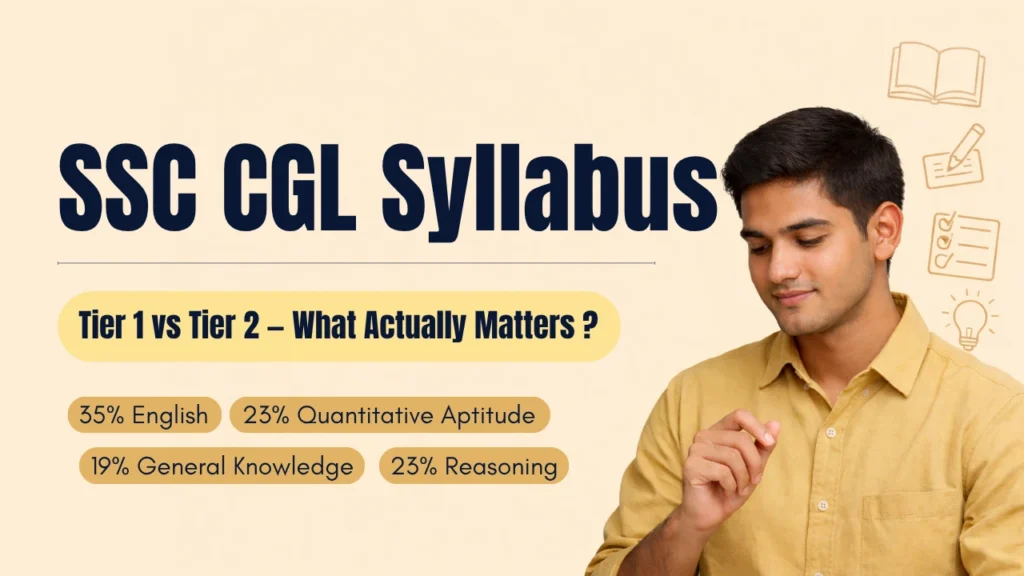
| 1st | English Language and Comprehension | 135 | 35% | Highest marks in the exam. The rank gap between candidates is largest here. |
| 2nd | Mathematical Abilities | 90 | 23% | Primary tiebreaker: Section I marks decide rank when total scores are equal. |
| 3rd | Reasoning and General Intelligence | 90 | 23% | Shares the Section I time window with Maths. Time split between the two is critical. |
| 4th | General Awareness | 75 | 19% | Highest return per preparation hour. Static GK topics repeat heavily across cycles. |
| Qualifying | Computer Knowledge and DEST | 60 + task | Pass or fail | Basic computer literacy for the test; daily typing practice for DEST. Do not over-invest. |
What Should You Do Next?
The syllabus tells you what exists. Your preparation plan needs to prioritise by frequency and weight, not by order of appearance on the topic list. Start with the subjects that carry the most marks and repeat most reliably across years: English, Geometry and Algebra in Maths, and Analogy-Coding-Series in Reasoning. Shift to Tier 2-specific material the day you submit your application. The Tier 1 to Tier 2 window is historically short in SSC CGL cycles.
Build Your Preparation Plan SSC CGL Preparation Tips 2026 — Topic-Wise Strategy and What Toppers Prioritise The syllabus is the map. This is the route: which topics to start, which to maintain, and which to drop when time is short.FAQ
Is the SSC CGL syllabus the same every year?
The core SSC CGL syllabus remains largely the same each year, but SSC may revise the exam pattern or add and remove sections. Always prepare using the latest official notification before starting your studies.
Can I prepare for Tier 1 and Tier 2 together?
Yes. Since both tiers cover the same core subjects, most successful candidates prepare for Tier 2 from the beginning and use Tier 1 mock tests to build speed and accuracy.
Does SSC officially release topic-wise weightage for the syllabus?
No. SSC publishes only the official syllabus. Topic-wise weightage is based on previous year paper analysis and may change from one exam cycle to another.
Which subject is the most important in the SSC CGL syllabus?
English carries the highest marks in Tier 2 Paper 1, while Mathematics is equally important because it contributes heavily to the score and plays a key role in tie-breaking during merit preparation.
Should I complete the entire SSC CGL syllabus before attempting mock tests?
No. Most toppers recommend starting previous-year papers and mock tests alongside syllabus completion. Regular mock analysis helps identify weak topics and improves exam strategy.