By Devesh Sunil Tatkare | Published: 31 March 2026 | Updated: 16 July 2026
The SSC CGL exam pattern tells you exactly what you are walking into: how many questions, how much time, what each wrong answer costs you. But more than that, it reveals where your rank is actually built and where you only need to survive. This guide covers the complete pattern for both tiers, what changed in the 2023 and 2025-26 formats, and what those changes mean for how you prepare now.
Quick Answer: SSC CGL has two tiers. Tier 1 is qualifying only: 100 questions, 200 marks, 60 minutes. Tier 2 is the merit exam. Paper 1 (compulsory for all) carries 390 scoring marks across English, Maths, Reasoning, and GA, plus two qualifying modules. Paper 2 (Statistics, 200 marks) is only for JSO applicants. Your final rank is built entirely in Tier 2. Tier 1 only decides who gets to sit for it. Paper 3 (Finance and Economics for AAO) was permanently removed from the 2025-26 cycle onwards.
What Does the SSC CGL 2026 Exam Pattern Look Like at a Glance?
Before going section by section, here is the full structure in one place so nothing surprises you on exam day.
| Tier | Mode | Total Questions | Total Marks | Duration | Counts for Merit? |
|---|---|---|---|---|---|
| Tier 1 | Computer-Based | 100 | 200 | 60 minutes | No (qualifying only) |
| Tier 2, Paper 1 | Computer-Based | 130 scoring + 20 qualifying + 1 DEST task | 390 scoring + qualifying | 2 hrs 30 min | Yes (determines rank) |
| Tier 2, Paper 2 | Computer-Based | 100 | 200 | 2 hours | Yes (JSO and Statistical Investigator only) |
The most consequential number in this table: 390. That is the total scoring marks in Tier 2 Paper 1, the only marks that actually build your rank. Everything else in both tiers is either qualifying or invisible to the merit list. Start there.
Also Read SSC CGL 2026 Complete Guide — Notification, Salary and Preparation Strategy Everything about SSC CGL 2026 in one place: vacancy, dates, eligibility, salary, and a step-by-step preparation plan.What Is the SSC CGL Tier 1 Exam Pattern?
Tier 1 screens who moves to Tier 2. Your score here does not appear in your final rank. The correct preparation goal for Tier 1 is to clear the cutoff consistently in mock tests, then shift your full focus to Tier 2 as early as possible.
The exam has 100 MCQ questions split equally across four subjects. Two marks per correct answer, minus 0.50 per wrong answer. Total time is 60 minutes with no section-wise lock, so you can move freely across all four subjects.
| Subject | Questions | Marks | Duration |
|---|---|---|---|
| General Intelligence and Reasoning | 25 | 50 | 60 minutes (composite, no section lock) |
| General Awareness | 25 | 50 | |
| Quantitative Aptitude | 25 | 50 | |
| English Comprehension | 25 | 50 | |
| Total | 100 | 200 | 60 minutes |
| Key Rule | Detail |
|---|---|
| Negative marking | -0.50 per wrong answer |
| Unattempted questions | No deduction |
| Language | Bilingual (Hindi and English) except English Comprehension |
| PwD candidates with scribe | 80 minutes total (20 extra minutes per hour) |
| Score normalisation | Applied when exam runs across multiple shifts using the equipercentile method |
| Minimum qualifying marks (UR) | 30% (60 out of 200) |
| Minimum qualifying marks (OBC/EWS) | 25% (50 out of 200) |
| Minimum qualifying marks (SC/ST/PwD/Ex-SM) | 20% (40 out of 200) |
Since Tier 1 marks do not count toward your rank, every hour you spend over-preparing for Tier 1 beyond a comfortable cutoff margin is an hour taken from Tier 2, where your rank is actually decided. Once your mock test scores consistently clear the cutoff, redirect your time.
What Is the SSC CGL Tier 2 Exam Pattern — and How Does It Actually Work?
Tier 2 is where everything is decided. Paper 1 runs in two sessions on the same day. Session 1 covers three sections across 2 hours 15 minutes. Session 2 is a 15-minute Data Entry Speed Test (DEST). Paper 2 (Statistics) runs on the same day as Paper 1, but only for JSO applicants.
Tier 2 Paper 1 — Compulsory for Every Post
| Session | Section | Subject | Questions | Marks | Weightage | Time |
|---|---|---|---|---|---|---|
| Session 1 (2 hrs 15 min) | Section I | Mathematical Abilities | 30 | 90 | 23% | 1 hour (locked) |
| Reasoning and General Intelligence | 30 | 90 | 23% | |||
| Section II | English Language and Comprehension | 45 | 135 | 35% | 1 hour (locked) | |
| General Awareness | 25 | 75 | 19% | |||
| Section III, Module 1 | Computer Knowledge Test | 20 | 60 | Qualifying only | 15 min | |
| Session 2 (15 min) | Section III, Module 2 | Data Entry Speed Test (DEST) | 1 task | Qualifying only | Qualifying only | 15 min |
| Total (scoring only) | 130 | 390 | 100% | |||
| Key Rule | Detail |
|---|---|
| Negative marking (Sections I and II, Module 1) | -1 mark per wrong answer (double the Tier 1 rate) |
| Negative marking (Paper 2, Statistics) | -0.50 per wrong answer |
| Computer Knowledge Test | Qualifying only; marks not counted in merit |
| DEST | Qualifying and mandatory for all posts; error rate must stay within category limit |
| Section qualification | Each section of Paper 1 must be individually cleared, not just the total |
| PwD candidates with scribe | Extra 20 minutes per hour across both sessions |
The Tier 2 negative marking trap: In Tier 1, a wrong answer costs 0.50. In Tier 2 Paper 1 (Sections I and II), it costs 1 full mark. An attempt strategy calibrated for Tier 1 will actively damage your Tier 2 score if you carry it forward without adjusting. Recalibrate your confidence threshold before the main exam.
Tier 2 Paper 2 — JSO and Statistical Investigator Gr-II Only
Paper 2 is only for candidates who applied for the Junior Statistical Officer (JSO) or Statistical Investigator Grade-II post. Both papers run on the same day.
| Subject | Questions | Marks | Duration | Negative Marking |
|---|---|---|---|---|
| Statistics | 100 | 200 | 2 hours (2 hrs 40 min with scribe) | -0.50 per wrong answer |
What Changed in the SSC CGL New Exam Pattern — and Why It Still Catches Candidates Out?
The revised SSC CGL pattern came into effect from the 2023 cycle. Many aspirants, especially those using older coaching material, have not fully updated their preparation framework to match it. Here is what changed and what it means in practice.
| Feature | Old Pattern | New Pattern (2023 onwards) |
|---|---|---|
| Number of tiers | 4 (Tier 1, 2, 3, 4) | 2 (Tier 1, Tier 2) |
| Tier 3 (Descriptive exam) | Present, pen and paper | Removed |
| Tier 4 (Skill test and CPT) | Separate stage | Merged into Tier 2 as the DEST module |
| Paper 3 (Finance and Economics) | Present for AAO posts | Permanently removed from the 2025-26 cycle onwards |
| Interview | Existed until 2016 | Permanently removed |
| Tier 2 negative marking | -0.50 per wrong answer | -1 mark per wrong answer (Sections I and II) |
| Section-wise time lock in Tier 2 | No lock, free movement | Yes, Section I and II each locked to exactly 1 hour |
The section time lock is the change most commonly missed: In Tier 2 Paper 1, Section I (Maths and Reasoning) and Section II (English and GA) each have a hard 1-hour window. You cannot carry over unused time from Section I to Section II. If you trained on mock tests without section-wise time locks, your practice time does not transfer accurately to the real exam. Always simulate with the lock active.
How These Stages Connect SSC CGL Selection Process 2026 — DEST Error Limit and Tiebreaker Rules Knowing the pattern is step one. Knowing how Tier 1 feeds Tier 2, what the DEST error rate actually disqualifies you for, and how SSC breaks a tie between equal total scores is step two.Where Should You Focus Your Preparation — Subject-Wise Weightage in Tier 2?
Not all sections carry the same weight or the same risk. Here is exactly where each subject sits in terms of its share of your final merit score, the negative marking rate, and the time constraint it operates under.
| Subject | Marks | Share of Final Score | Negative Marking | Time Constraint |
|---|---|---|---|---|
| English Language and Comprehension | 135 | 35% | -1 per wrong | Within 1-hour Section II window |
| Mathematical Abilities | 90 | 23% | -1 per wrong | Within 1-hour Section I window |
| Reasoning and General Intelligence | 90 | 23% | -1 per wrong | Within 1-hour Section I window |
| General Awareness | 75 | 19% | -1 per wrong | Within 1-hour Section II window |
| Computer Knowledge Test | 60 | Qualifying only | -1 per wrong | 15 min |
| Data Entry Speed Test (DEST) | Not scored | Qualifying only | None | 15 min |
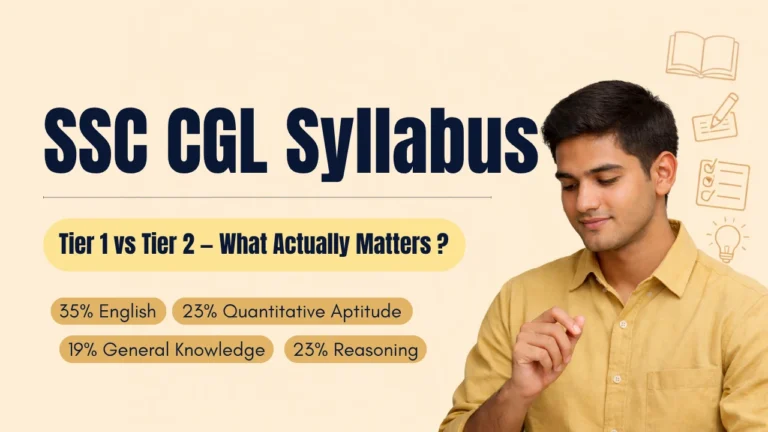
English carries 35% of your final score. Maths and Reasoning together carry 46%. Those three subjects account for 81% of what decides your rank. GA at 19% matters, but the rank gap between candidates opens widest in English and Maths. If your preparation time is limited, the priority order is clear: English first, then Maths, then Reasoning, then GA.
The Three Pattern Mistakes That Quietly Damage Tier 2 Scores
Every guide explains what the exam pattern is. Very few explain what candidates consistently get wrong when they try to prepare for it. These three mistakes are pattern-specific, not generic preparation advice.
Preparing for Tier 2 without the section time lock active. This is the most common structural error. Section I is locked to 1 hour and Section II is locked to 1 hour. If your mock tests let you freely move across all subjects for the full 2 hours 15 minutes, you are training a skill you cannot use in the real exam. A candidate who has spent 80 mock tests ignoring section boundaries will freeze when the system locks them out of Section II at the 1-hour mark, regardless of how much time they technically have left. Every Tier 2 mock test must simulate the exact lock structure.
Carrying Tier 1 attempt confidence into Tier 2. In Tier 1, attempting a question you are 60-65% confident about is usually worth the risk: wrong costs 0.50, right earns 2. In Tier 2, wrong costs 1 full mark. The same attempt decision now carries twice the downside. Candidates who consistently over-attempt in Tier 2 because they never recalibrated their confidence threshold from Tier 1 systematically lose 15 to 30 marks to negative marking. Raise your minimum confidence threshold before the first Tier 2 mock.
Ignoring the DEST error limit. Most preparation treats DEST as purely a typing speed test. The maximum allowable error rate is the rule almost no guide covers clearly. For General and UR candidates, exceeding a 20% error rate disqualifies you from the DEST entirely. Since DEST is mandatory, that disqualification removes your candidature for the post, regardless of how well you performed in the rest of Tier 2. Practise for accuracy within the error limit, not just for raw speed.
The specific error rate limits by category:
- General and UR candidates: Maximum 20% error rate
- OBC and EWS candidates: Maximum 25% error rate
- SC, ST, PwD, and Ex-Servicemen: Maximum 30% error rate
SSC CGL vs IBPS PO vs SBI PO Exam Pattern: Which Is Actually Harder?
Candidates deciding between competitive exams often compare them on difficulty alone. The more useful comparison is structure: where your rank is built, how many attempts you get, and whether the descriptive component adds a skill barrier that changes preparation time. Here is the honest comparison across all three.
| Feature | SSC CGL Tier 2 | SBI PO Mains | IBPS PO Mains |
|---|---|---|---|
| Negative Marking | -1 per wrong (Sections I and II) | -0.25 per wrong | -0.25 per wrong |
| Descriptive Component | None (DEST is typing speed, not writing) | Yes, 50 marks (Letter + Essay, 30 min) | Yes, 25 marks (Letter + Essay, 30 min) |
| Interview Stage | No interview | Yes, Group Exercise + Interview (50 marks) | Yes, Interview (100 marks) |
| Rank Basis | Tier 2 objective marks only | Mains + Descriptive + Interview combined | Mains + Interview combined |
| Section Time Lock | Yes (1 hour per section) | Yes (per section) | Yes (per section) |
The key structural difference: SSC CGL has no interview and no descriptive component, which means your entire merit rank is built on objective MCQ performance. SBI PO and IBPS PO both carry interview stages worth 30 to 100 marks that introduce a subjective element outside your control. For candidates who perform well in objective exams but less confidently in interviews, SSC CGL's structure is a meaningful advantage, not just a pattern feature.
After You Clear the Pattern SSC CGL Salary 2026 — Post-Wise In-Hand Pay and What the Numbers Actually Mean Once you understand the exam structure, the next question is which post to target. In-hand salary varies by over 10,000 per month between two Level 7 posts purely due to allowances.What Should You Do Next?
The pattern is the map, not the destination. Now that you know where each mark comes from and what each rule costs on a wrong attempt, the preparation decision becomes specific: start Tier 2 simulation from the day you submit your application. The gap between Tier 1 results and Tier 2 is historically short in SSC CGL cycles, and every week of Tier 2 preparation you build now is a week you do not have to recover later.
Verify Before You Prepare SSC CGL Eligibility Criteria 2026 — Age Limits, Physical Standards and Education Rules Physical standards apply to Inspector and Sub-Inspector posts only. Colour blindness is a hard disqualifier for those specific roles. Check which posts you can actually hold before spending months preparing for them.FAQ
Does SSC CGL Tier 1 score count in the final merit list?
No. Tier 1 is only a qualifying stage. Your final merit and post allocation are based on Tier 2 marks (along with Paper 2 for eligible JSO candidates).
Is there an interview in SSC CGL?
No. SSC CGL recruitment does not include an interview. Selection is based on Computer-Based Tests, qualifying skill tests (where applicable), and document verification.
What happens if I fail the DEST in SSC CGL?
If the Data Entry Speed Test (DEST) is mandatory for your post and you fail it, you will not be considered for that post even if you score well in Tier 2.
Has the SSC CGL exam pattern changed in 2026?
Yes. The latest notification continues the revised two-tier format, and Paper 3 (Finance & Economics) has been removed. Candidates should prepare according to the current official pattern instead of older study materials.
Is there sectional timing in the SSC CGL exam?
Yes. Under the latest pattern, both Tier 1 and Tier 2 have section-wise time limits, so you cannot use unused time from one section in another.