By Devesh Tatkare | Published: 19 July 2026
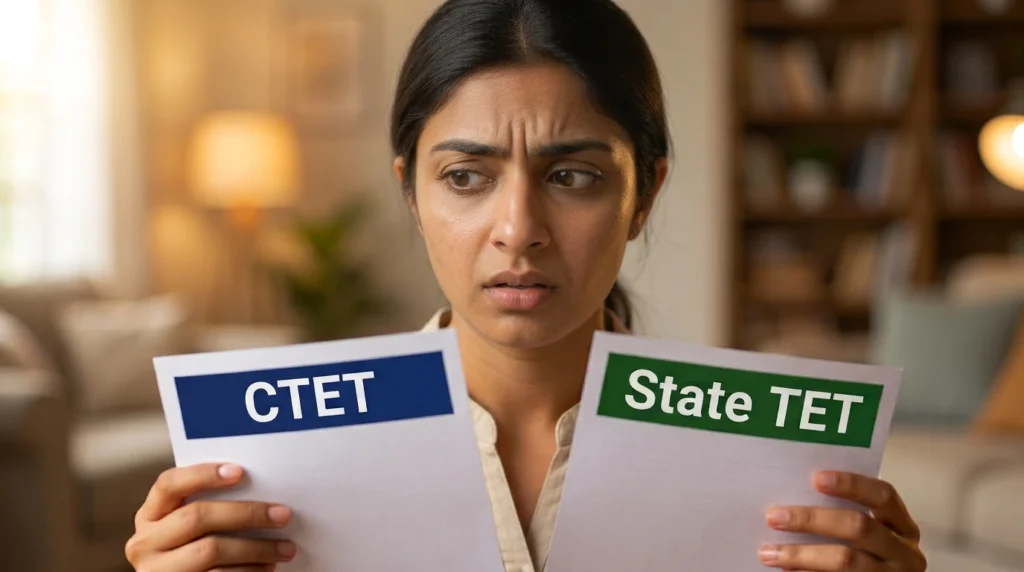
Every year, B.Ed. graduates prepare for the wrong exam and find out too late. Some clear a State TET, then discover the KVS or NVS vacancy they wanted only accepts CTET. Others clear CTET, then find their home state's board still insists on the state-specific TET. This choice decides which jobs you can actually apply for.
Quick Answer: CTET is CBSE's national exam, valid for life, for central schools like KVS and NVS anywhere in India. State TET is run separately by each state board and only qualifies you for that state's government and aided schools. Want a state school near home? Take that state's TET. Want national reach, including CBSE private schools? Take CTET. Most serious aspirants take both.
What Is CTET?
CTET, conducted by CBSE, certifies you against the minimum teaching standard for central institutions: Kendriya Vidyalayas, Navodaya Vidyalayas, Union Territory schools, and many CBSE-affiliated private schools. It runs twice a year with no upper age limit.
New to CTET itself? The Go DeeperRead the full CTET Beginner GuideEligibility, application process, and paper-wise breakdown covers eligibility and application basics before you compare further.
What Is State TET?
State TET is the same idea at state level, run by each state's own board, for example UPTET, REET, or WBTET. It qualifies you for that state's government and aided schools only, it doesn't transfer elsewhere or substitute for CTET.
Syllabus overlaps heavily with CTET, but most State TETs add a mandatory regional-language paper. If that's not your first language, budget real prep time, it trips up more candidates than pedagogy does.
CTET vs State TET: What Actually Decides Your Choice
Strip away the syllabus overlap and three things matter: who conducts the exam, where the certificate works, and how long it stays valid.
| Aspect | CTET | State TET |
|---|---|---|
| Conducted by | CBSE (central government) | Respective state education board |
| Where it's valid | Anywhere in India, central schools | Only within that state, state schools |
| Frequency | Twice a year | Depends on state vacancy cycle, often once a year or irregular |
| Language requirement | Choice of multiple languages, no regional mandate | Usually includes a compulsory regional-language paper |
| Age limit | None | Depends on the recruiting state and post |
| Validity of certificate | Lifetime | Varies by state, some lifetime, some fixed years |
CTET vs State TET Eligibility: Who Can Apply
Base eligibility follows NCTE's framework for both: Senior Secondary plus a two-year Diploma in Elementary Education, or a Bachelor's degree plus B.Ed., depending on paper and level.
The real difference is domicile and language. CTET has no domicile rule, anyone from any state can apply. Several State TETs favour or require domicile for reserved posts, and nearly all expect the state's official language.
Example: Ravi, from Bihar, doesn't need Delhi domicile for CTET. But a Delhi state-quota post could still carry domicile or language conditions from that specific recruitment notice, not the TET notice. Always check the actual notification before assuming eligibility.
CTET vs State TET Syllabus: How Different Is the Preparation?
Roughly 70-80 percent overlaps: Child Development and Pedagogy, Language I and II, Mathematics, and Environmental Studies or Social Studies, in a 150-question, no-negative-marking format across 150 minutes.
The rest is where State TETs add local pedagogy references, policy questions, and a regional-language paper CTET doesn't carry. Strong CTET prep gets you close to State TET-ready, not fully there, so build state material on top rather than starting both from scratch.
CTET vs State TET Validity: The Part Most Candidates Get Wrong
CBSE made CTET valid for a lifetime in 2021, following NCTE's revised guidelines, replacing the old seven-year rule. This still holds in 2026, every qualifying CTET score stays valid indefinitely, no reappearing required.
State TET validity isn't standardised the same way. Some states have matched lifetime validity, others still run a fixed term, commonly seven years, after which you'd need to reappear if not yet recruited. This varies by state and can change with policy updates.
CTET vs State TET Salary and Career Outcomes
Neither exam pays you directly, both are eligibility gates, not appointments. Your salary depends on the specific post you're recruited into afterward. As a general pattern, KVS or NVS posts requiring CTET follow central pay commission scales with central HRA and DA rates, while state school salaries follow that state's own pay scale, which varies with state finances and post grade. Treat any salary figure you see online as an example from one recruitment, not a guarantee, and check the actual notification you're applying to.
Which Should You Choose: CTET, State TET, or Both?
Choose CTET if you want to apply across India, are open to relocating, or are targeting KVS, NVS, or CBSE-affiliated private schools.
Choose your State TET if you're committed to your home state and comfortable with its language requirement.
Choose both for maximum security. Take Priya, in Maharashtra, unsure if she'll stay long-term: MAHTET secures her state options, CTET keeps KVS, NVS, and other CBSE postings open if plans change. Since syllabus overlaps, the second exam needs far less incremental prep once the first is done.
Short on time before an upcoming cycle? Prioritise whichever exam matches this year's actual job target, and treat the other as a next-cycle addition.
What Should You Do Next?
Check the current cycle on the official CBSE CTET portal, or your state board's own TET notification, since application windows and eligibility are confirmed only in the current notice, not older articles. Planning to sit for both? Register for whichever window opens first and use it as your base prep for the second.
Still unclear on CTET's own eligibility or application steps? Start with the Next StepCTET Beginner GuideFull eligibility, application process, and paper breakdown before deciding anything else.
FAQs
Is CTET harder than State TET?
Difficulty depends more on competition than content, since syllabi overlap heavily. CTET draws a larger pool, pushing cutoffs higher, while State TET difficulty varies by state.
Can I use my State TET certificate for a KVS or NVS job?
No. KVS and NVS recruitment requires CTET specifically, State TET is not an accepted substitute.
If I clear CTET, do I still need my State TET?
Usually yes, for that state's own recruitment, unless the specific notification accepts CTET as equivalent. Check the notification directly.
Is State TET validity also lifetime?
Depends on the state. Some have adopted lifetime validity, others still use a fixed term like seven years. Confirm on your state board's official website.
Is KVS and NVS the same?
No, KVS (Kendriya Vidyalaya Sangathan) and NVS (Navodaya Vidyalaya Samiti) are not the same. While both are premier autonomous organizations under India's Ministry of Education and follow the CBSE curriculum, they serve different primary demographics and have distinct school environments.