By Devesh Sunil Tatkare | Published: 28 February 2026 | Updated: 15 July 2026
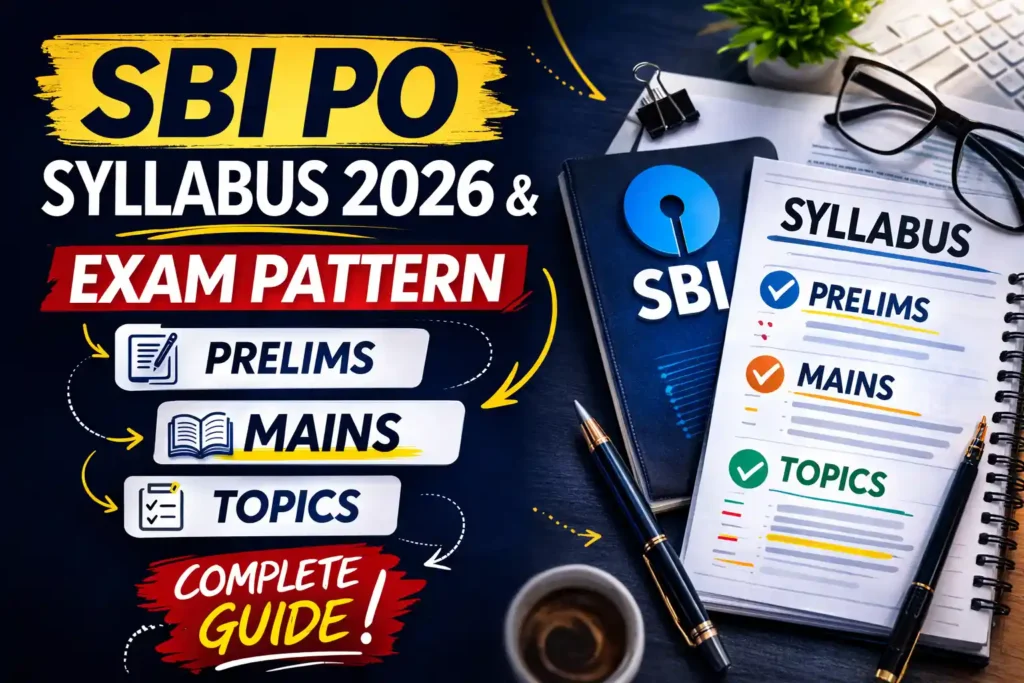
Once you have confirmed your SBI PO eligibility, the next question is deceptively simple: what do you actually study, and how does the exam decide who clears? Most guides dump a phase table and stop there. This article covers both — the complete 2026 exam pattern, section-wise syllabus, marking rules, topic priorities, and the one decision most preparation articles skip entirely: how to allocate your limited preparation time before you open a single book.
Quick Answer: SBI PO 2026 runs across three phases. Phase I (Prelims) is 100 marks in 60 minutes and is qualifying only — no merit value. Phase II (Mains) is 200 marks objective plus 50 marks descriptive and is where your actual rank is built. Phase III is Group Exercise (20 marks) and Personal Interview (30 marks), combined and normalised to 25. Your final score is out of 100: Mains contributes 75 and Phase III contributes 25.
What Does the SBI PO 2026 Exam Structure Look Like From Start to Finish?
The SBI PO selection process runs across three phases in sequence. You must clear each phase to sit for the next. Only Phase II and Phase III marks count toward your final merit rank. Here is the full structure at a glance:
| Phase | Type | Marks | Counted in Final Merit? |
|---|---|---|---|
| Phase I - Prelims | Objective (MCQ) | 100 | No — Qualifying only |
| Phase II - Mains (Objective) | Objective (MCQ) | 200 | Yes — Scaled to 75 |
| Phase II - Mains (Descriptive) | Typed on computer | 50 | Yes — Part of Mains score |
| Phase III - Group Exercise | Group Discussion | 20 | Yes — Combined with PI, scaled to 25 |
| Phase III - Personal Interview | Interview Panel | 30 | Yes — Combined with GE, scaled to 25 |
Final Merit Formula: Mains (out of 250) normalised to 75 marks + Group Exercise and Interview (out of 50) normalised to 25 marks = Final score out of 100. Normalisation means your raw marks are statistically adjusted for difficulty differences across exam shifts before building the merit list. Your rank can shift even after raw scores are announced.
What Does the SBI PO Prelims Pattern Look Like in Practice?
Prelims is a 100-mark, 60-minute objective test split across three hard-timed sections. SBI shortlists roughly ten times the number of vacancies, so the margin between qualifying and missing the list is often just 2 to 3 marks. Recent exam cycles show a consistent pattern: Puzzle complexity in Reasoning has increased, DI sets now require multi-step calculations, and English passages are longer and inference-heavy. Filler questions are shrinking.
Section-Wise Prelims Pattern: Questions, Marks, and Time
| Section | Questions | Marks | Time Limit |
|---|---|---|---|
| English Language | 30 | 30 | 20 Minutes |
| Quantitative Aptitude | 35 | 35 | 20 Minutes |
| Reasoning Ability | 35 | 35 | 20 Minutes |
| Total | 100 | 100 | 60 Minutes |
The 60-minute total is divided into three hard 20-minute sections enforced by the system. Once a section's timer hits zero, it locks permanently. Unused seconds cannot be carried to the next section. Treat each section as its own standalone 20-minute exam.
No Sectional Cut-off in Prelims — What This Means: SBI filters Prelims candidates on aggregate only. But the overall cutoff is consistently high enough that ignoring any one section almost always produces a disqualifying total. Balanced preparation across all three sections is not optional.
What Is the Complete SBI PO Prelims Syllabus for 2026?
The Prelims syllabus is narrower than Mains. Its job is to filter candidates fast, not test deep knowledge. Here is what each section tests, with topic weights from recent cycles.
English Language (30 Marks)
English in Prelims leans heavily on reading and vocabulary in context. Reading Comprehension and Cloze Test together account for roughly 60% of English marks in most recent Prelims cycles. The high-frequency topics from recent papers:
- Reading Comprehension — one passage, 5 to 7 questions including vocabulary-in-context; expect inference-heavy questions, not direct retrieval
- Cloze Test — 5 to 7 blanks, usually testing preposition and connector choice
- Error Detection and Para Jumbles — 3 to 5 questions each
- Fill in the Blanks, Phrase Replacement, and Sentence Improvement — 3 to 5 questions combined
Quantitative Aptitude (35 Marks)
Quant tests speed and calculation accuracy more than conceptual depth at the Prelims stage. The highest-return topic clusters, in order of marks per hour of preparation:
- Number Series — 5 questions; pattern-based, usually solvable in 30 to 40 seconds each once you see the logic
- Quadratic Equations — 5 questions; predictable format, high accuracy yield if practised
- Simplification and Approximation — 5 to 10 questions; BODMAS-heavy, solvable without full calculation if you estimate confidently
- Data Interpretation — one or two sets with 5 questions each; bar charts, line graphs, tables; multi-step calculations in recent cycles
- Arithmetic Word Problems — Profit and Loss, SI and CI, Time and Work, Speed Distance Time, Ratio, Averages, Percentages, Mixtures; 6 to 10 questions spread across topics
Reasoning Ability (35 Marks)
Reasoning is where Prelims time pressure hits hardest. Puzzles and Seating Arrangements alone account for nearly half the section's marks — and they are the slowest question type. The distribution from recent cycles:
- Puzzles and Seating Arrangements — 15 to 20 questions across 3 to 4 sets; the highest single-topic weightage in the entire Prelims
- Syllogism — 3 to 5 questions; usually fast if you know the elimination method
- Inequalities — 3 to 5 questions; mechanical, high accuracy if practised
- Coding-Decoding, Blood Relations, Direction Sense, Order and Ranking, Alphanumeric Series — 1 to 3 questions each
The Most Common Reasoning Time-Management Failure: Getting stuck on a complex puzzle in the first 8 minutes and running out of time for the mechanical questions at the back. Scan the puzzle types before committing — easy puzzles exist even in hard papers, and identifying them first is itself a skill worth practising.
Verify First SBI PO Eligibility Criteria 2026 — Age, Nationality and Qualification Rules Before you start preparing for the pattern, confirm you actually qualify. Age relaxations and attempt limits catch candidates more often than the exam itself does.How Is the SBI PO Mains Exam Structured in 2026?
Every mark in Mains counts toward your final rank. The Mains runs as a 3-hour Objective Test followed immediately by a 30-minute Descriptive Test on the same terminal — no break separates them, and the Descriptive starts the moment the Objective timer ends.
Mains Objective Test: Section-Wise Breakdown
| Section | Questions | Marks | Time Limit |
|---|---|---|---|
| Reasoning and Computer Aptitude | 45 | 60 | 60 Min |
| Data Analysis and Interpretation | 35 | 60 | 45 Min |
| General / Economy / Banking Awareness | 40 | 40 | 35 Min |
| English Language | 35 | 40 | 40 Min |
| Total | 155 | 200 | 3 Hours |
Sectional Cut-offs Apply in Mains: Unlike Prelims, each Mains section carries its own minimum qualifying score. Falling below the minimum in even one section disqualifies you from Phase III — regardless of your total Mains score. A strong overall total does not compensate for a section-level failure.
Mains Descriptive Test: What You Actually Need to Write
The Descriptive Test runs for 30 minutes, is worth 50 marks, and carries its own qualifying score. It is typed directly on the exam computer in English. Question types that appear in recent cycles: Letter Writing, Essay Writing, Email Writing, Situation Analysis, and Precis Writing. No negative marking applies, but evaluation is strict on format adherence, structural clarity, word count discipline, and grammatical accuracy. A candidate who clears the Objective cut-offs comfortably can still lose significant ranking with a weak Descriptive performance. The Descriptive is not a formality — 50 marks at the merit stage equals 15 Objective questions answered correctly.
What Is the Complete SBI PO Mains Syllabus for 2026?
Mains tests depth, not just speed. Each section has grown more complex in recent cycles. Here is what each section tests — with the specific shifts most candidates miss when preparing from older resources.
Reasoning and Computer Aptitude (60 Marks)
This section combines logical reasoning with applied computer knowledge. Both halves carry marks; neither is optional. The Reasoning component covers: complex multi-variable puzzles, Critical Reasoning (Statement-Assumption, Cause-Effect), Input-Output series, and Data Sufficiency. The Computer Aptitude component covers: Flowchart tracing and Binary Logic, Cyber Security fundamentals (phishing, encryption basics, data breach types), Networking concepts (LAN, WAN, protocols), and basic Database Management Systems (DBMS) terminology.
Data Analysis and Interpretation (60 Marks)
This section has shifted significantly in recent cycles — away from straightforward graph reading toward multi-step caselet formats. Current topic breakdown: Tabular DI, Bar and Line Graphs, Pie Charts, Missing Data Caselets (where you calculate from partial information), Probability-Based DI, Data Sufficiency, and Quantity Comparison sets. If your Quant preparation is still focused on simple graph reading, it does not reflect what the Mains currently tests.
General / Economy / Banking Awareness (40 Marks)
This section splits between static banking knowledge and current affairs from the last 6 months. Static topics: RBI structure and functions, Basel III norms, CRR, SLR, Repo Rate and Reverse Repo Rate, Priority Sector Lending categories, and financial inclusion schemes. Current Affairs: RBI Monetary Policy announcements, Union Budget highlights, Digital Rupee (CBDC) developments, UPI and NPCI announcements, banking sector appointments, and INR trade settlement updates. Banking Awareness is almost entirely current-affairs-driven in recent SBI PO cycles. Six months of consistent reading of RBI publications delivers more marks per hour than almost any other single Mains preparation activity.
English Language (40 Marks)
Mains English is significantly harder than Prelims English. Passage length increases to 700-900 words, inference questions become more abstract, and the writing component becomes more nuanced. Topics: Long Reading Comprehension, Cloze Test, Para Jumbles, Error Detection, Word Usage and Vocabulary, Sentence Connectors, and Paragraph Completion.
What Is the SBI PO Marking Scheme and Negative Marking Rule?
Every wrong answer in the Objective sections costs 0.25 marks. The rule most don't think through: marking 4 wrong answers costs you exactly 1 mark — the equivalent of one correct answer. High-risk guessing on questions you cannot reasonably eliminate is not neutral; it is actively costly at the margin, where a 1-mark difference can change your rank by hundreds of places.
| Component | Marks | Negative Marking | Sectional Cut-off |
|---|---|---|---|
| Prelims Objective | 100 | 0.25 per wrong answer | No — Aggregate only |
| Mains Objective | 200 | 0.25 per wrong answer | Yes — Per section |
| Mains Descriptive | 50 | No | Yes — Qualifying marks |
| Group Exercise | 20 | No | No |
| Personal Interview | 30 | No | No |
What Happens in Phase III: Group Exercise and Personal Interview?
Phase III is where candidates who cleared Mains are evaluated for fit and communication, not just exam knowledge. It is the smallest contributor to final merit (25 out of 100) but the hardest to recover from if underprepared, because there is no second attempt within the same cycle.
The Psychometric Test comes first — a behavioral assessment used as reference material by the interview panel. It has no independent pass/fail outcome. The Group Exercise (20 marks) evaluates argument quality, listening ability, and collaborative contribution — not speaking volume or frequency. The Personal Interview (30 marks) covers banking knowledge, RBI policies, current affairs, and your motivation for joining SBI specifically. Both components are combined and normalised to 25 marks in the final merit calculation.
SBI PO vs IBPS PO: Which Exam Has a Different Structure That Changes How You Prepare?
Both exams test banking aptitude, but the structure differs enough that preparing for one does not automatically prepare you well for the other. This comparison covers the structural differences that affect your preparation decisions — not just surface-level syllabus overlap.
| Parameter | SBI PO | IBPS PO |
|---|---|---|
| Conducting Body | State Bank of India (direct recruitment) | Institute of Banking Personnel Selection (for multiple banks) |
| Prelims Pattern | 100 Marks, 60 Min, 3 sections, 20-min hard cap per section | 100 Marks, 60 Min, 3 sections, 20-min cap per section — nearly identical format |
| Mains Marks | 200 Objective + 50 Descriptive = 250 Mains marks | 200 Objective + 25 Descriptive = 225 Mains marks — less weight on writing |
| Descriptive Weight | 50 marks — significant merit impact | 25 marks — qualifying in nature, lower impact on rank |
| Phase III | Group Exercise + Personal Interview (scaled to 25) | Personal Interview only (scaled into final merit) |
| Sectional Cut-offs (Mains) | Yes — all sections | Yes — all sections |
| Number of Banks | One (SBI only) | Multiple participating public sector banks |
SBI PO places more weight on the Descriptive Test than IBPS PO, and adds a Group Exercise that IBPS PO does not have. If you are strong in objective sections but weaker in structured writing, IBPS PO carries lower relative risk on that dimension. If you are prepared across all components, SBI PO's single-bank structure means one predictable career ladder rather than allotment uncertainty across multiple banks.
How Should You Decide Where to Focus Your Preparation Time — and What Most Plans Get Wrong?
Knowing the syllabus and knowing where to spend your preparation hours are two different things. Three structural preparation mistakes show up repeatedly in SBI PO cycles, each costing marks at a stage where the margin is narrow.
Treating Prelims and Mains as the same exam at different difficulty levels. They are not. Prelims rewards speed and accuracy in a narrow topic set. Mains rewards depth, analytical capacity, and current-affairs breadth. Candidates who practice only Prelims-style speed drills through to Mains typically find their Banking Awareness and Descriptive performance significantly underprepared — those topics barely appear in Prelims at all.
Skipping Computer Aptitude in Mains preparation. It sits inside the largest-mark Mains section (60 marks). Flowchart tracing, binary logic, and Cyber Security basics are learnable in a few concentrated sessions. Most candidates skip them because they "feel like IT topics" — which means most candidates lose 10 to 15 marks they could have taken with two weeks of focused work.
Saving Descriptive writing practice for after the Objective is "ready." The Descriptive runs immediately after the Objective ends, with no mental reset. Candidates who have not practised typing formal letters and essays under timed conditions consistently underperform on format and word count. Start Descriptive practice at the Mains stage, not as a last-minute addition.
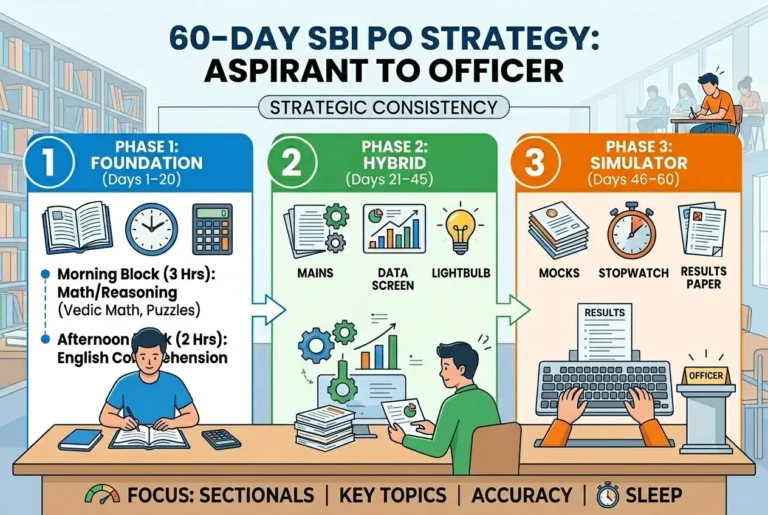
Next Step SBI PO Study Plan 2026 — 60-Day Phase-Wise Preparation Strategy Now that you know the full pattern and what each section tests, follow the preparation sequence that covers every component without burning out before Mains.What Should You Do Next?
The exam pattern is fixed. What changes every cycle is the competition level and the current-affairs content that Banking Awareness tests. Two things matter most right now: locking in your section-wise Prelims strategy before you start solving practice sets, and building a consistent current-affairs reading habit at least six months before the expected Mains date. Start with your weakest section in Prelims — that is the one most likely to pull your aggregate below the cutoff on a hard paper. Then build Mains foundations in parallel, not after Prelims results drop.
Worth Knowing Before You Commit SBI PO Retirement Age and Pension Rules 2026 — Full Career Arc The career path that starts at PO ends at a defined age ceiling with a specific pension structure. Understanding the long-term financial picture helps you weigh this role against alternatives before putting in months of preparation.FAQ on SBI PO Exam Pattern and Syllabus
Is there negative marking in SBI PO 2026?
Yes. Both Prelims and Mains objective exams have a negative marking of 0.25 marks for every incorrect answer.
Does Prelims marks count in the SBI PO final merit?
No. Prelims is only qualifying in nature. Only Mains and Phase III marks are considered for the final merit list.
Is there a sectional cut-off in SBI PO?
There is no sectional cut-off in Prelims, but Mains has sectional qualifying marks for each section.
Is the SBI PO interview compulsory?
Yes. Candidates who qualify Mains must appear for the Group Exercise and Personal Interview to be considered for final selection.
Which section is the most important for SBI PO Mains?
Reasoning & Computer Aptitude and Data Analysis & Interpretation carry the highest weightage with 60 marks each, making them the most important scoring sections.