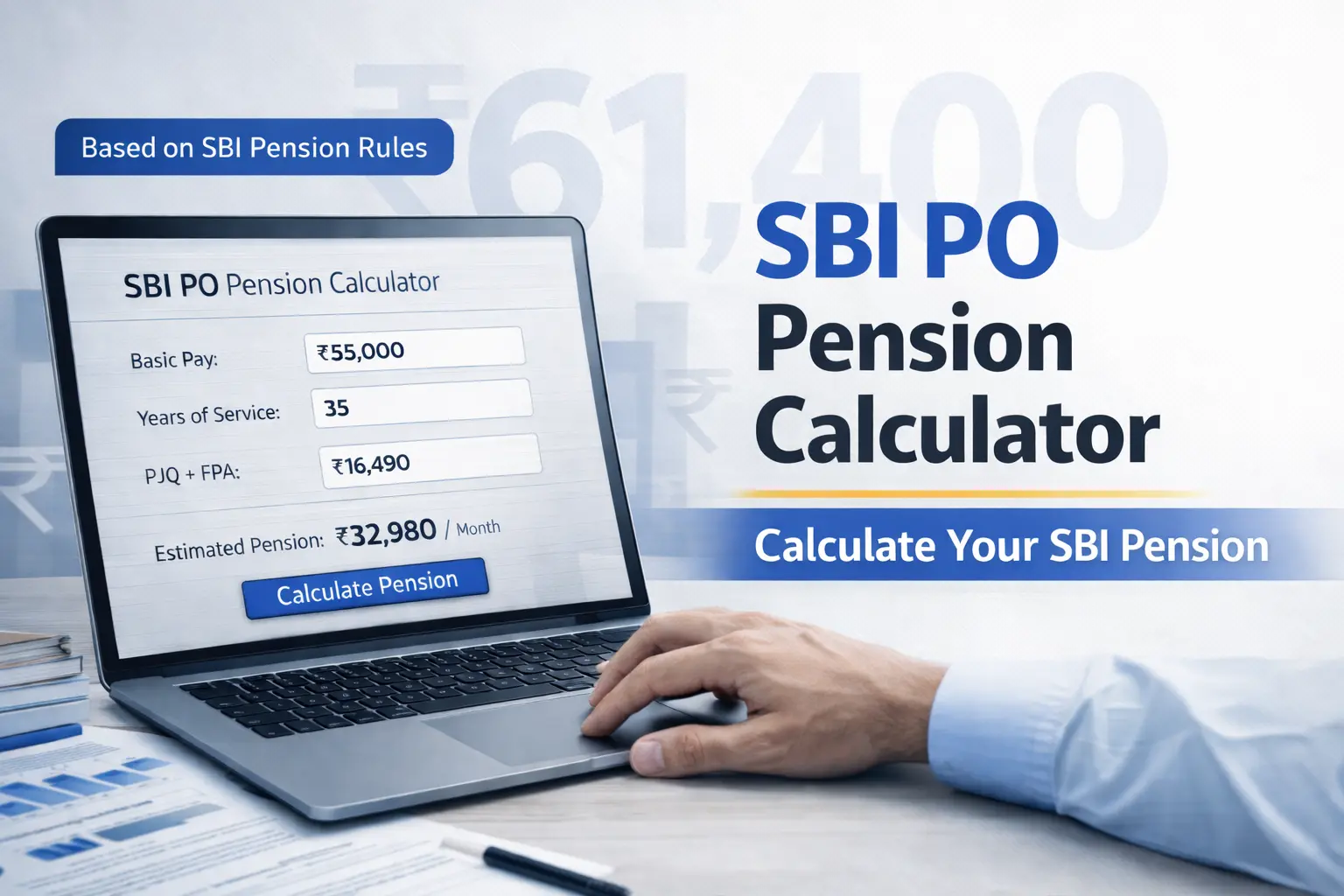
Retirement Benefits Calculator
Estimate your Gratuity, Pension, DR & Leave Encashment
Component-wise Breakdown
By Devesh Sunil Tatkare | Published: 06 March 2026 | Updated: 15 July 2026
If you are an SBI officer nearing retirement, or an aspirant mapping out a long-term banking career, the biggest question is simple: “How much will I actually receive when I retire?” Most online tools only calculate NPS, but SBI employees who joined before August 2010 fall under the completely different SBI Pension Fund Rules. Built using the latest SBI Handbook for Retiring Officials, this guide breaks down exactly how the bank calculates your dual gratuity, commutation, and monthly pension.
Quick Answer: SBI calculates your pension using two formulas under the Pension Fund Rules: (a) Average Salary multiplied by Pensionable Months divided by 720, and (b) a flat 50% or 40% of Basic Pay (plus PQA and FPA). Your final basic pension is the lower of the two figures. For gratuity, the bank calculates payouts under both the Gratuity Act and its internal slab formula, and pays you the higher amount (capped at ₹20 lakhs).
What Is the Official SBI PO Retirement Age and Effective Date?
The retirement age for all SBI employees, including Probationary Officers, is strictly 60 years. Your effective date of retirement (superannuation) is always the last day of the month in which you turn 60. Eligibility for the old pension scheme depends entirely on your joining date, but the superannuation age remains the same for every grade.
| Retirement Benefit | How the Bank Pays It |
|---|---|
| Gratuity | Higher of the Gratuity Act formula or the SBI internal formula (Capped at ₹20 lakh) |
| Basic Pension | Lower of the two formulas under the SBI Pension Fund Rules |
| Dearness Relief (DR) | Percentage of basic pension, revised every 6 months by the IBA |
| Commutation | Trade one-third of basic pension for a lump sum, fully restored after 15 years |
| Leave Encashment | Up to 240 days of Privilege Leave encashed, tax-exempt up to ₹3 lakh |
The Timeline Rule: Paperwork for these benefits does not process automatically on your last day. You must actively initiate the claims via HRMS at least three months before your retirement date to ensure uninterrupted cash flow.
How Is Your SBI Pension Actually Calculated?
For employees who joined before 1 August 2010, the bank computes your pension using two specific formulas and assigns the lower of the two as your monthly basic pension. This calculation trips up many officers who assume they simply receive 50% of their last drawn salary.
Formula A: The Service-Based Calculation
Basic Pension = Average Substantive Salary × Pensionable Months ÷ 720
Your “Average Substantive Salary” includes your Basic Pay, Incremental FPA, and PQA over your last 12 months. This formula heavily rewards long service: the closer you get to 720 months (60 years), the higher the multiplier.
Formula B: The Percentage-Based Calculation
This formula applies flat percentages based on salary bands:
- If your average salary is ₹51,490 or less: Your pension is 50% of Basic Pay plus half PQA plus half FPA.
- If your average salary is above ₹51,490: Your pension is 40% of Basic Pay (with a minimum floor of ₹25,745) plus half PQA plus half FPA.
Pro Tip: Formula A usually yields a higher number for officers with over 33 years of service. Because the bank pays the lower of the two, Formula B will likely become your actual finalised pension if you have a very long service record.
Early Exit Conditions SBI PO Retirement Age 2026 — VRS and Medical Rules Leaving before 60 changes your pension eligibility entirely. Check the exact years of service required to trigger a pension before opting for early retirement.SBI Old Pension vs NPS: Which System Covers You?
Two entirely different retirement systems exist within SBI. The system you fall under is determined strictly by your joining date, and there is no option to switch between them.
| Feature | SBI Pension Fund (Old Scheme) | National Pension System (NPS) |
|---|---|---|
| Eligibility | Joined before 1 August 2010 | Joined on or after 1 August 2010 |
| Pension Type | Formula-based (Guaranteed by the fund) | Market-linked accumulated corpus |
| Commutation Option | Up to one-third of basic pension as a lump sum | Up to 60% of the total corpus as a lump sum |
| Inflation Adjustment | IBA-declared Dearness Relief every 6 months | No automatic inflation indexation |
Important Note: If you joined SBI on or after 1 August 2010, the old pension formulas do not apply to you at all. You are under NPS, and your final payout will depend on market returns and annuity rates, not the formulas above.
How Does SBI Calculate Your Gratuity?
SBI uses a dual-formula approach for gratuity and pays whichever calculation results in the higher amount (subject to a ₹20 lakh ceiling effective 29 March 2018). Gratuity is typically the largest single lump sum an officer receives at retirement.
1. Payment of Gratuity Act (1972) Formula
Gratuity = Wages × 15 × Completed Years ÷ 26
For officers, “Wages” includes Basic Pay, DA, FPA, and PQA.
2. SBI Internal Slab Formula
This internal formula tiers the payout based on years of service:
- First 15 years of service: Basic Pay × 15
- Years 15 to 30: Basic Pay × Extra Years ÷ 4
- Years above 30: Basic Pay × Extra Years ÷ 2
How Does Pension Commutation Work?
Commutation allows you to surrender up to one-third of your basic pension in exchange for an immediate, tax-free lump sum. The bank calculates this using a specific age-based factor table. For a standard retirement at age 60, the commutation factor at age 61 (next birthday) is 6.60.
Formula: One-third × Basic Pension × Commutation Factor × 12
The deducted portion of your pension is fully restored after exactly 15 years. If your basic pension is ₹30,000, commuting one-third gives you an immediate lump sum of ₹7,92,000, while your monthly pension temporarily reduces to ₹20,000 (plus full DR) for 15 years.
What Are the Most Common Pension Mistakes SBI Officers Make?
Retirement planning is not just about the formulas. It is about avoiding the administrative errors that permanently reduce your payouts. The following three mistakes cost officers lakhs of rupees every year.
Ignoring Service Deductions. Periods of Extraordinary Leave (EOL), Loss of Pay (LOP), and suspension directly reduce your pensionable service months. Even a 60-day gap can permanently lower your final monthly pension.
Forgetting the Leave Encashment Limit. You can encash up to 240 days of Privilege Leave at retirement. Failing to accumulate or track this leave is equivalent to leaving lakhs on the table.
Fearing Commutation. Many officers avoid commutation because they think the pension reduction is permanent. It isn’t. Your full pension is legally restored after 15 years, while the immediate lump sum can clear housing loans today.
What Documents Do You Need Before Your Last Day?
Do not wait for your superannuation date. Start verifying these records with your PPG Department at least 3 months in advance to ensure your first pension payment arrives on time.
- Confirm your exact Date of Birth matches across all HRMS records.
- Verify your total pensionable service years with the PPG Department.
- Submit your formal pension option form (declaring with or without commutation).
- Collect No Objection Certificates (NOCs) from all departments for loans and quarters.
What Should You Do Next?
If you are approaching retirement, log into Employee Self Service on HRMS today to verify your exact service record and PF balance. Contact the PPG Department at your Local Head Office early. The formulas above are fixed, but the paperwork timeline is on you.
FAQs
Who is eligible for the SBI old pension scheme?
Employees who joined SBI before 1 August 2010 are covered under the SBI Pension Fund Rules. Employees joining on or after that date fall under the National Pension System (NPS).
Can I calculate my SBI pension online?
Yes. You can estimate your retirement benefits using an SBI pension calculator, but the final pension amount is verified by SBI based on your service records and applicable pension rules.
Is SBI gratuity taxable after retirement?
Gratuity is generally tax-exempt up to the limit prescribed under the Income Tax Act, provided the applicable conditions are met.
Can I receive both pension and gratuity from SBI?
Yes. Eligible SBI employees can receive both gratuity and pension, as they are separate retirement benefits governed by different rules.
Can I commute my SBI pension after retirement?
Yes. Eligible pensioners can commute up to one-third of their basic pension into a lump sum, and the commuted portion is restored after the prescribed restoration period.